How much of your time is spent on documentation instead of patients?
Anamneses, reports, doctor's letters, and progress documentation cost valuable time every day. This time is then missing for treating patients and for your own private life.

How often do you ask the same routine questions every day – over and over again?
Allergies, pre-existing conditions, medications, complaints: much of this is repeated at every appointment. This costs time, energy, and attention that is actually needed for individual assessment.

How often is the exact information missing that should be somewhere in the preliminary report?
PDFs, scans, and old letters are available — but often not in a format that allows for quick work. Instead of clarity, searching becomes a burden, especially when time is short.

How much time is lost when language becomes a barrier?
Language barriers complicate anamnesis, require additional time, and can distort or lose important information. This burdens both patients and practitioners.

How much time is lost when crucial knowledge isn't immediately accessible?
SOPs, guidelines, and workflows are often scattered. New employees take longer to onboard, and knowledge constantly needs to be re-explained.

How quickly does time pressure become a data privacy issue?
When formulations need to be quick, employees often resort to freely available AI tools. Sensitive patient data ends up in applications not intended for clinical use.
ClioAssist transforms clinical workflows, creates efficiency, and provides relief where time is most scarce.
Patients bring a wide variety of documents – medical letters, lab reports, expert opinions, etc. ClioAssist automatically reads and structures these documents, sorts them chronologically, and extracts the medically relevant information.

Patients conduct an AI-supported pre-anamnesis interview with specialist-specific questions in their preferred language. The questions can be individually adapted and expanded by doctors.
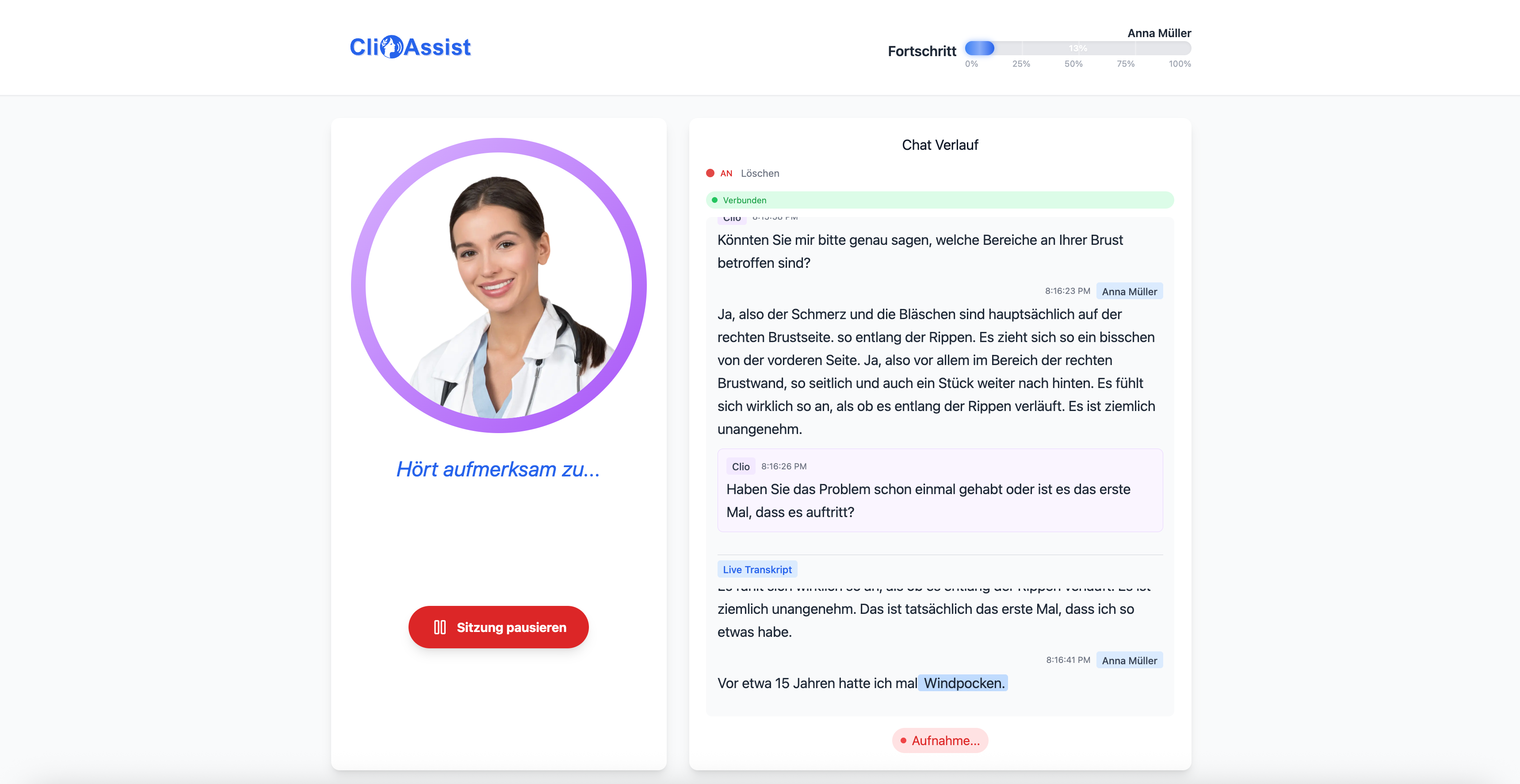
ClioAssist transcribes the doctor-patient conversation in real-time, translates if necessary, and creates preliminary reports that doctors can review and transfer to the PVS.

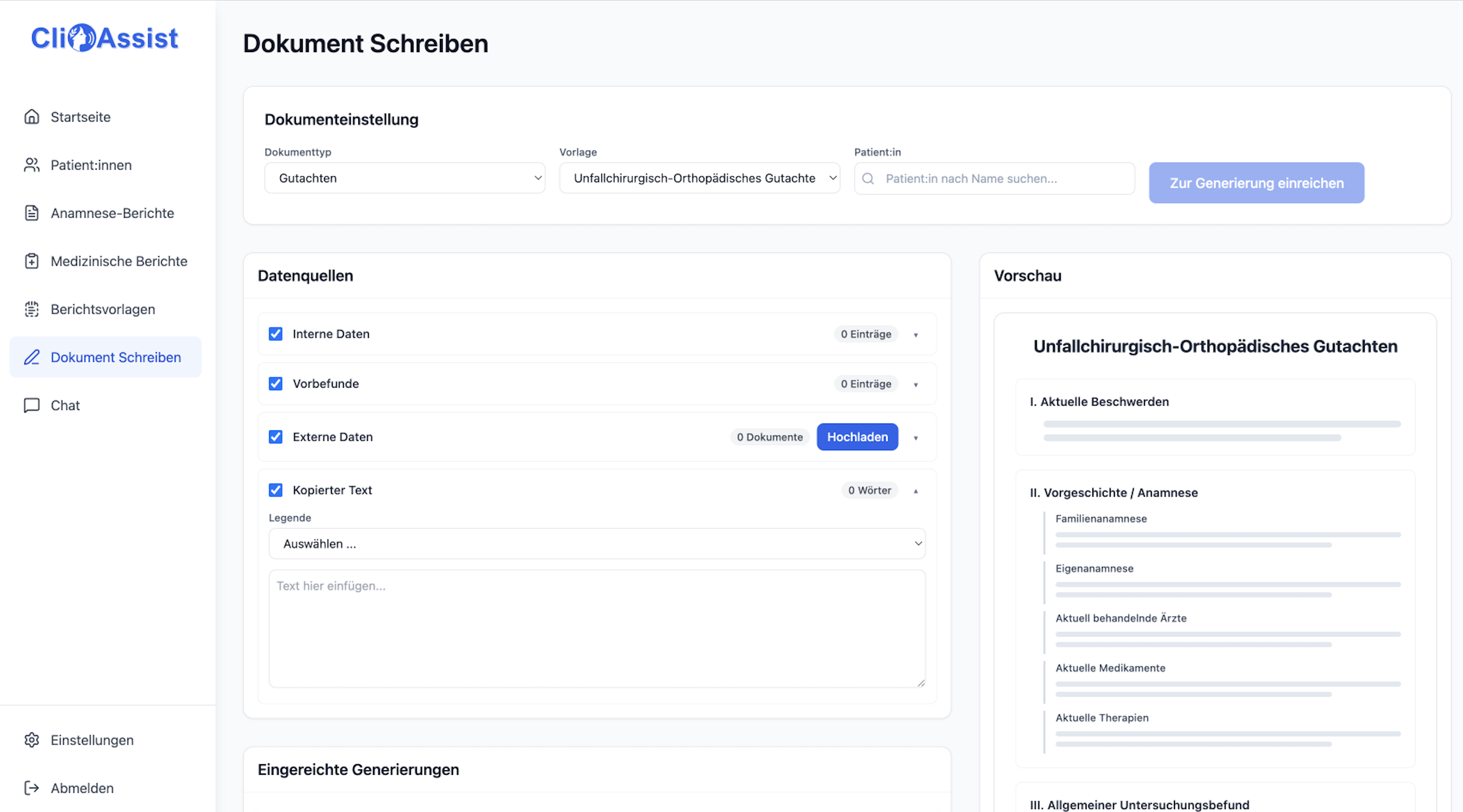
ClioAssist assists doctors in drafting and refining medical documents by integrating data from various sources and formats.
ClioAssist supports multiple languages and translates in real-time, allowing patients and doctors to communicate in their own respective languages.

The chat helps teams directly access internal knowledge, SOPs, and relevant information, and formulate texts professionally. This facilitates onboarding and relieves experienced employees, as knowledge doesn't constantly need to be re-explained.

Patients bring a wide variety of documents – medical letters, lab reports, expert opinions, etc. ClioAssist automatically reads and structures these documents, sorts them chronologically, and extracts the medically relevant information.
Patients conduct the admission interview in their preferred language with our Voice AI in a private room. ClioAssist automatically generates a structured report from this, optimally preparing doctors for the conversation.
With a tablet during each ward round, ClioAssist can transcribe the conversation. ClioAssist continuously documents the entire stay.

At the end of the stay, ClioAssist automatically generates a draft discharge letter from various sources: previous findings, conversation notes.

ClioAssist supports multiple languages and translates in real-time, allowing patients and doctors to communicate in their own respective languages.
The chat helps teams directly access internal knowledge, SOPs, and relevant information, and formulate texts professionally. This facilitates onboarding and relieves experienced employees, as knowledge doesn't constantly need to be re-explained.
Less documentation effort, more time for real medicine


Conducts conversations like you and documents like you – leaving more time for real medicine.
Yes, ClioAssist is easy to integrate with your existing systems. For practice management systems (PVS), ClioAssist supports the GDT interface, allowing recorded documentation to be transferred directly to the PVS. If your clinic has a functional HL7 FHIR server, ClioAssist can in principle be connected to any hospital information system (HIS).
No, absolutely not. ClioAssist runs completely locally. This means that both your patient data and the AI models remain within your own infrastructure. There is no external training using your data. ClioAssist has no access to your data.
ClioAssist is operated locally at your practice or facility. For practices, we offer a package including a pre-configured GPU server and suitable microphones. This already includes the technical foundation for local operation.
The cost of ClioAssist depends on the specific scope of use. The key factors are how many healthcare professionals will use ClioAssist, whether suitable hardware is already available, and which support services are required.In general, the more healthcare professionals use ClioAssist, the lower the price per user becomes.
If hardware is needed, our partners can provide flexible hire-purchase or leasing models for our offerings, depending on your requirements. This makes it possible to get started without a high upfront investment.We would be happy to provide free advice on the hardware requirements and prepare an individual offer based on your needs.
Yes, absolutely. Adapting ClioAssist to the needs of your practice or clinic is an integral part of our service. We work with you to review which documentation tasks in your daily workflow are particularly time-consuming, configure suitable templates, and optimize ClioAssist so that the AI fits your requirements and writing style.
Yes, when ClioAssist transcribes conversations, the patient should give their express consent in advance. However, the legal basis for merely processing patient data for documentation purposes can usually already be established within the treatment relationship.
English, Ukrainian, Turkish, Arabic, Polish, Russian, Italian, French, Spanish, Chinese
Book an appointment for a demo online

info@clioassist.de

phone
+49 (0) 15679626323

Office hours
Monday to Friday: 09:00 - 18:00
ClioAssist GmbH
Pommersche Strasse 12, 10707 Berlin
Patient data remains in your institution at all times. Our AI runs completely locally on your hardware, without the cloud, ensuring maximum privacy and full compliance with all health regulations.
Book a demo nowSupported by:
University Medical Center Mainz, Medical University Lausitz - Carl Thiem