How often do patients have to answer the same questions again in different departments?
Anamneses, reports, doctor's letters, and progress documentation cost valuable time every day. This time is then missing for treating patients and for your own private life.

How often is more than half the day reserved for doctor’s letters, reports, and documentation?
Doctor’s letters, discharge reports, progress notes, and summaries of findings take up significant medical capacity every day. Time that should be used for ward rounds, conversations, decisions, and patient care often ends up being spent on writing.

How quickly does time pressure become a data protection problem?
When documentation or wording has to be done quickly, staff may turn to freely available AI tools. Sensitive patient data can then end up in applications that are not designed or approved for clinical use.
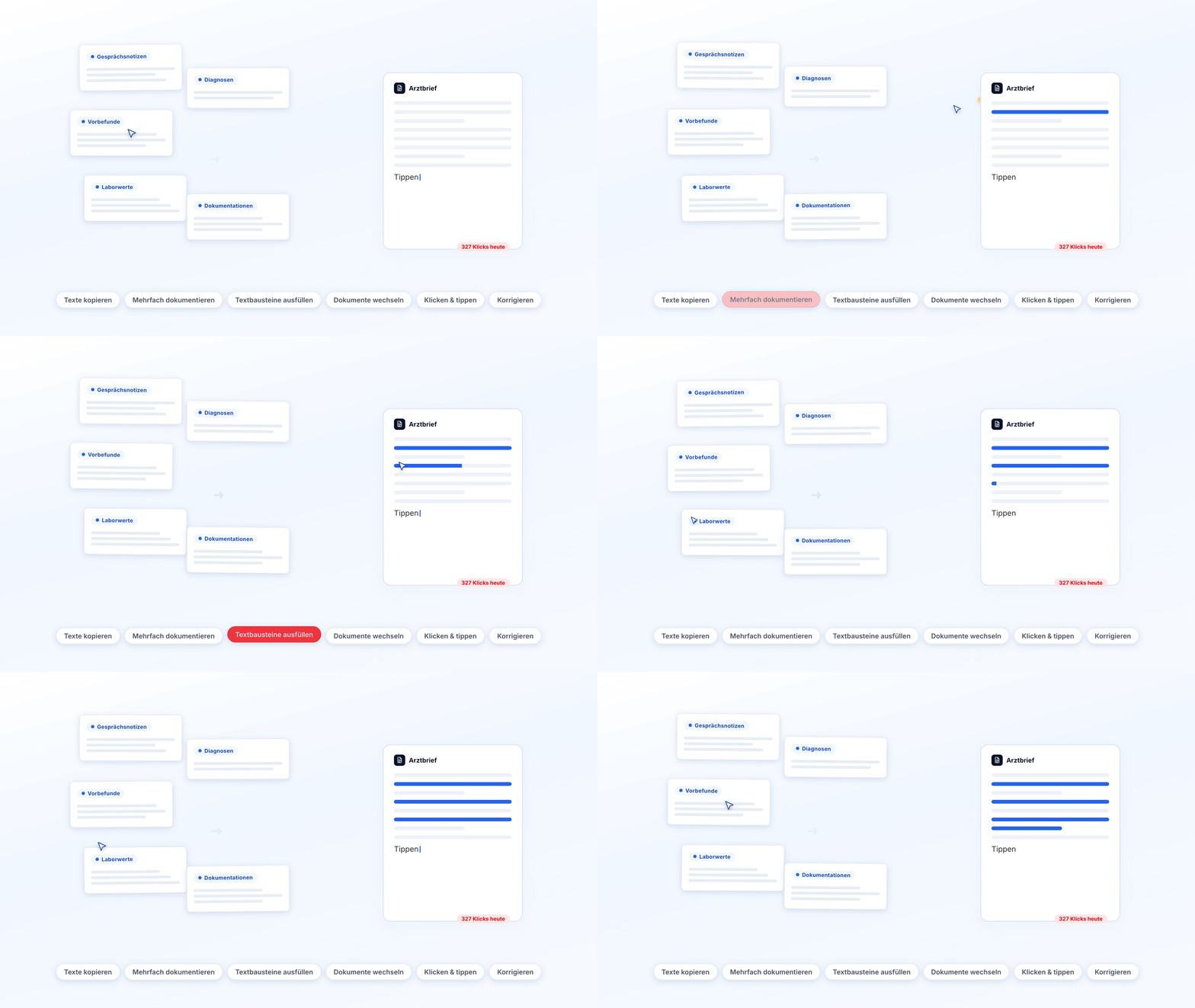
Von der Aufnahme bis zum fertigen Bericht:
ClioAssist unterstützt Ihr Team genau dort, wo heute die meiste Dokumentationszeit verloren geht.
ClioAssist führt Patient:innen Schritt für Schritt durch die Routinenfragen in der Anamnese – per KI-Gespräch, Text-Chat oder interaktiver Befragung. Die Informationen stehen danach für Aufnahme, Station, Fachabteilungen und Dokumentation wiederverwendbar zur Verfügung.
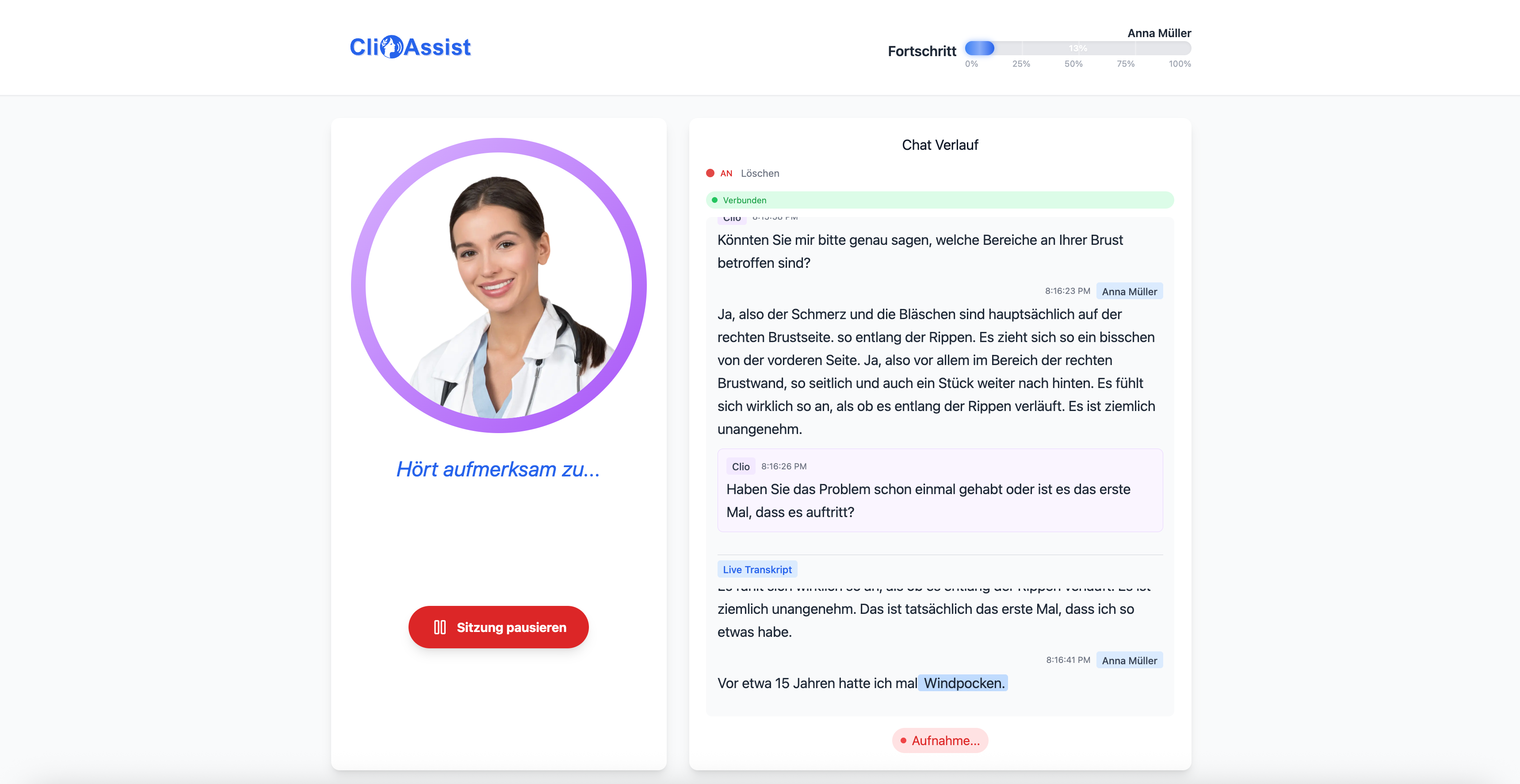
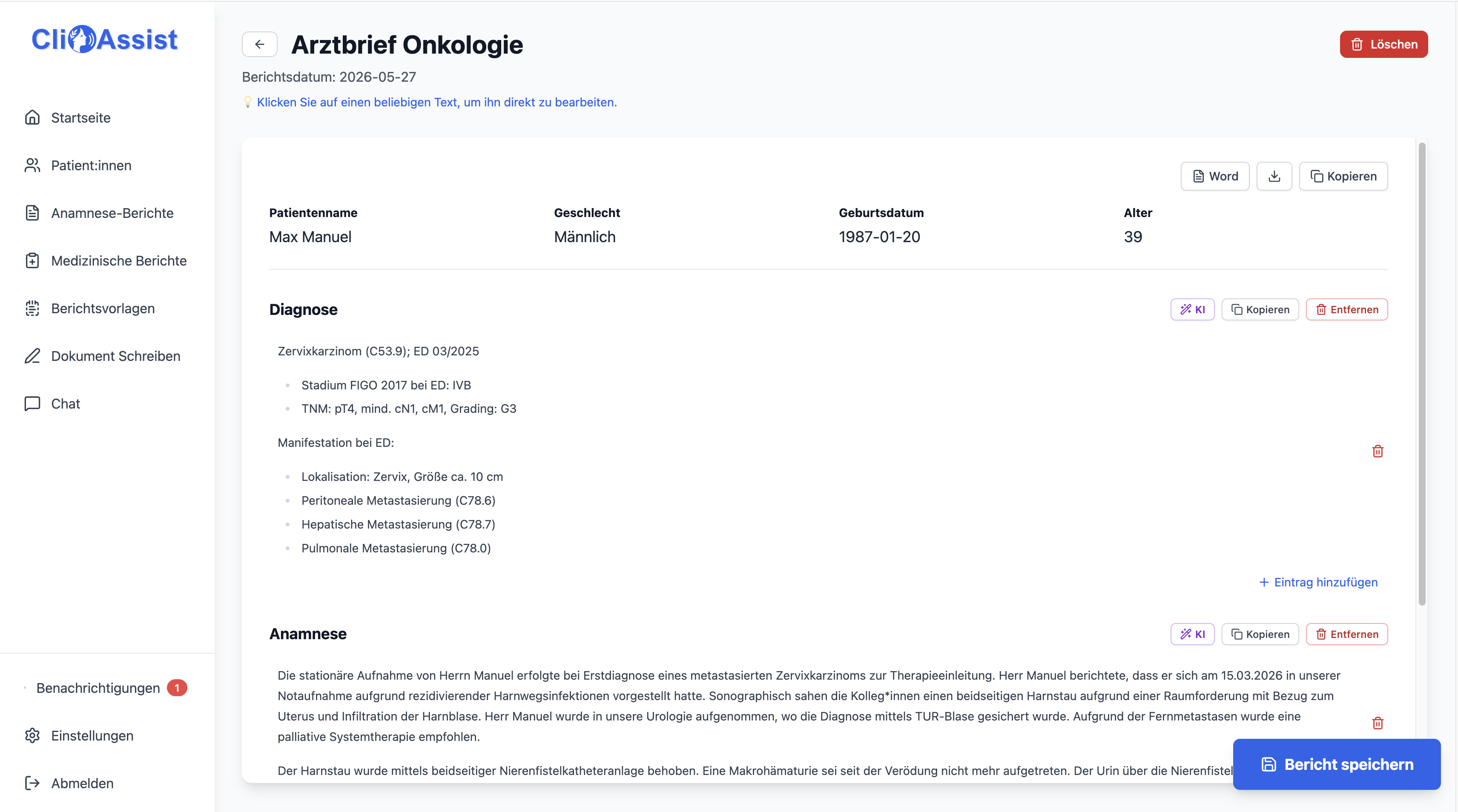
ClioAssist verwandelt Gespräche und Verlaufsinformationen in strukturierte Arztbrief-Entwürfe — spart Ärzt:innen täglich Stunden und reduziert Informationsverlust entlang des Behandlungsverlaufs.
ClioAssist ermöglicht KI-Nutzung in freigegebenen Klinikprozessen – lokal, datensouverän und datenschutzkonform. So vermeiden Sie unsichere Shadow-IT und behalten die Kontrolle über sensible Patientendaten. Gleichzeitig unterstützt der ClioAssist Chat Ihr Team dabei, internes Wissen, SOPs und relevante Informationen direkt abzurufen, Texte professionell zu formulieren und neue Mitarbeitende schneller einzuarbeiten.

Reduzieren Sie doppelte Anamnesen, ärztliche Schreibarbeit und unsichere Shadow-IT — lokal, datensouverän und datenschutzkonform.
Yes, ClioAssist can be integrated into existing hospital systems. For hospital information systems, ClioAssist supports modern interfaces such as HL7 FHIR, allowing relevant patient data to be connected in a structured way and documentation to be transferred into existing processes.If your hospital already has an HL7 FHIR server, ClioAssist can be connected quickly. If no HL7 FHIR server is available yet, we will work with your IT department and, if necessary, your HIS provider to assess which integration options are suitable and technically feasible.
No, absolutely not. ClioAssist runs completely locally. This means that both your patient data and the AI models remain within your own infrastructure. There is no external training using your data. ClioAssist has no access to your data.
ClioAssist can be operated locally in your hospital or in a private cloud environment. If your organization already has suitable GPU resources, we install ClioAssist on the existing infrastructure and integrate the solution into your current IT and server structures.
If additional hardware is required, we support you with free technical consultation. Together, we clarify which GPU, server, and network requirements are necessary for your departments, user numbers, and planned use cases.
The cost of ClioAssist depends on the specific scope of use. The key factors are how many healthcare professionals will use ClioAssist, whether suitable hardware is already available, and which support services are required. In general, the more healthcare professionals use ClioAssist, the lower the price per healthcare professional becomes.
If hardware is needed, our partners can provide flexible hire-purchase or leasing models for our offerings, depending on your requirements. This makes it possible to get started without a high upfront investment. We would be happy to provide free advice on the hardware requirements and prepare an individual offer based on your needs.
Yes, absolutely. Adapting to the needs of your practice or clinic is an integral part of our service. Together with you, we identify which documentation tasks are particularly time-consuming in daily operations, configure suitable templates, and optimize ClioAssist so that the AI meets your requirements and writing style.
Yes, when ClioAssist transcribes conversations, the patient should give their express consent in advance. However, the legal basis for merely processing patient data for documentation purposes can usually already be established within the treatment relationship.
English, Ukrainian, Turkish, Arabic, Polish, Russian, Italian, French, Spanish, Chinese
Book an appointment for a demo online

info@clioassist.de

phone
+49 (0) 15679626323

Office hours
Monday to Friday: 09:00 - 18:00
ClioAssist GmbH
Pommersche Strasse 12, 10707 Berlin
Patient data remains in your institution at all times. Our AI runs completely locally on your hardware, without the cloud, ensuring maximum privacy and full compliance with all health regulations.
Book a demo nowSupported by:
University Medical Center Mainz, Medical University Lausitz - Carl Thiem